


Choosing a summer program in high school often comes down to a quiet trade-off. Some programs offer freedom but little academic pressure. Others promise research but require families to pay college-level tuition. A smaller group sits somewhere else entirely: selective, free, and demanding. MITES Summerbelongs to this category.
You usually consider MITES when you are less interested in sampling STEM and more interested in testing whether you can survive it at a college pace. Students who choose MITES often turn it down instead of pay-to-participate programs because they want structure, evaluation, and feedback rather than certificates or credits.
The program does not advertise itself as enrichment. It functions more like a compressed academic semester, designed to show you what sustained technical work actually feels like before senior year.
What Is MITES Summer?
MITES Summer is a fully funded, residential STEM program hosted by the Massachusetts Institute of Technology. It is intended for high school juniors who want sustained exposure to college-level coursework in science, mathematics, and the humanities.
Rather than focusing on one discipline, MITES requires you to operate across several at the same time. You live on campus, follow a structured academic schedule, and complete coursework that mirrors the expectations of a demanding undergraduate semester.
Is MITES Summer Selective?
Yes. MITES Summer is a highly selective, academically rigorous summer offering. MIT does not publish acceptance rates, but public comments and alumni reporting place selection in the low single digits, often estimated around 1–4%, with thousands of applicants competing for roughly 60–80 seats each year. There is no minimum GPA or test score cutoff, yet the coursework assumes strong preparation in math and science and the ability to keep up with fast-paced, college-level instruction. Selectivity at MITES Summer is tied directly to rigor. The program was built to identify students with high academic potential who have had limited access to advanced STEM opportunities, students from under-resourced schools, low-income families, and first-generation college backgrounds.
10 Reasons the MITES Program Is Worth It for High School Students
Students often choose MITES Summer for practical reasons tied to how the program is designed:
Cost: MITES covers tuition, housing, meals, and materials. You only pay for travel. This removes financial pressure and keeps the focus on academics.
Structure: The program follows a fixed daily schedule with classes, assignments, and exams. There is little flexibility. Students who want a disciplined routine tend to prefer this setup.
Breadth: You study math, physics, life sciences, and humanities at the same time. This mirrors the workload of early college semesters and helps students avoid narrowing too early.
Academic Rigor: Courses move at a college pace and assume independent learning. Students choose MITES when they want to test their ability to keep up with demanding material.
Placement by Readiness: Course placement is based on diagnostic assessments, not grade level alone. This helps ensure you are challenged appropriately, regardless of your high school’s offerings.
Evaluation Style: Instead of grades or credits, you receive written instructor evaluations. These focus on problem-solving, effort, and growth over time.
Workload Reality Check: Daily homework, midterms, and finals are part of the program. Many students choose MITES to understand what sustained academic pressure actually feels like.
Access to Academic Support: Teaching assistants, recitations, and office hours are built into the program. You learn how to seek and use help effectively.
Peer Environment: You work alongside students who are academically motivated and serious about STEM. This peer setting often pushes students to raise their own standards.
Clarity Before Senior Year: MITES helps students assess strengths, weaknesses, and interests before college applications. Many choose it for the clarity it provides, not for credentials.
Program Overview
Host institution: Massachusetts Institute of Technology
Program type: Residential, in-person
Location: MIT campus, Cambridge, Massachusetts
Program length: Six weeks; Typically runs from late June to early August
Cost: Free. (Housing, meals, coursework, and materials are covered). You are responsible only for transportation to and from campus
Application timeline: Applications usually open in late fall and close in early February
Eligibility: High school juniors (current 11th graders) who are U.S. citizens or permanent residents.
MITES Summer is a six-week, residential program at MIT that drops high-achieving high school students straight into campus life. You live on campus. You move through five demanding courses across math, science, and the humanities. The academics go well beyond standard school syllabi, advanced math and science sit alongside applied electives like machine learning, architecture, and genomics, areas most classrooms never reach. Outside the classroom, students rotate through lab tours and campus events that make MIT feel less abstract and more lived-in. Held from late June to early August, MITES Summer is designed to show what serious STEM study looks like, while sharpening the academic habits and independence needed to handle college-level work.
Academic Structure and Subject Exposure
MITES Summer does not allow you to specialize narrowly. Instead, it forces breadth and stamina.
You take five courses simultaneously, usually including:
- Mathematics
- Physics
- Life sciences
- Humanities
- One project-based elective
Placement for math, physics, and biology is determined through a diagnostic inventory at the start of the program. This matters. Students are not grouped by grade level but by demonstrated readiness, which means you are often working alongside peers with uneven academic backgrounds but similar problem-solving ability.
Courses move quickly and assume you will adapt:
Mathematics: Topics can range from precalculus through multivariable calculus, depending on placement. The focus is on symbolic manipulation, proof-style reasoning, and applying formal methods under time pressure.
Physics: Courses emphasize modeling physical systems, dimensional reasoning, and translating word problems into equations. Expect frequent problem sets rather than demonstrations.
Life Sciences: Instruction often centers on molecular biology and genetics. You work through pathways, mechanisms, and data interpretation rather than memorization.
Humanities: You analyze how scientific work interacts with social systems, ethics, and policy. Writing and argumentation are graded seriously.
Project-Based Elective: Electives vary by year but often include areas like engineering design, architecture, electronics, machine learning, or genomics. These courses emphasize applied thinking and collaborative output rather than exams alone.
Admissions & Eligibility
MITES Summer is highly selective and competitive. The program is open to rising high school seniors (11th graders) who are U.S. citizens or permanent residents. Public, private, and homeschooled students are all eligible to apply.
Application Requirements:
- Online Application: Submitted through mitesapp.mit.edu
- Academic Information: GPA, transcript, coursework details
- Test Scores (Optional but Encouraged): SAT, ACT, or other standardized test scores
- Three Required Recommendations:
- One Math or Science teacher
- One Humanities teacher
- One School counselor or administrator (who uploads the transcript and school profile)
- Essays: Multiple essay questions exploring your interest in STEM and your personal background
Admissions Quick Facts:
- Eligibility: U.S. citizens or permanent residents in 11th grade
- Application Materials: Online application, transcript, 3 recommendations, essays, and optional test scores
- Acceptance Rate: Not publicly disclosed, but highly competitive
- Decisions Released: Mid-April
The program particularly encourages applications from students who are underrepresented in STEM fields (African American/Black, Hispanic/Latinx, Native American, Alaska Native, Native Hawaiian, or Pacific Islander), from low socioeconomic backgrounds, potentially first-generation college students, from families without science/engineering degrees, or from high schools with low admittance rates to top-tier colleges. You can apply to both MITES Summer and MITES Semester (the online version) through the same application, though if accepted, you’ll only receive an offer for one program.
Skills Developed through the program
MITES Summer builds habits you use every day. The learning is practical. Most of it comes from handling several tough courses at the same time, with little room to coast.
Academic and Technical Skills
- Solving college-level math and physics problems under time constraints
- Reading scientific and technical material quickly and accurately
- Applying concepts from biology, physics, and math to unfamiliar problems
- Writing clear, structured analytical responses in humanities coursework
- Presenting technical work and explaining your reasoning to others
Computational and Applied Skills (varies by elective)
- Basic programming or computational thinking in project-based courses
- Working with data, models, or design constraints in applied STEM projects
- Translating theoretical ideas into practical outputs or prototypes
Research-Adjacent Skills
- Breaking down open-ended questions into manageable steps
- Interpreting results rather than following fixed procedures
- Revising work based on instructor and peer feedback
Learning and Workflow Skills
- Managing heavy workloads across multiple subjects
- Prioritizing tasks under tight deadlines
- Using office hours, recitations, and peer study groups effectively
Student Feedback
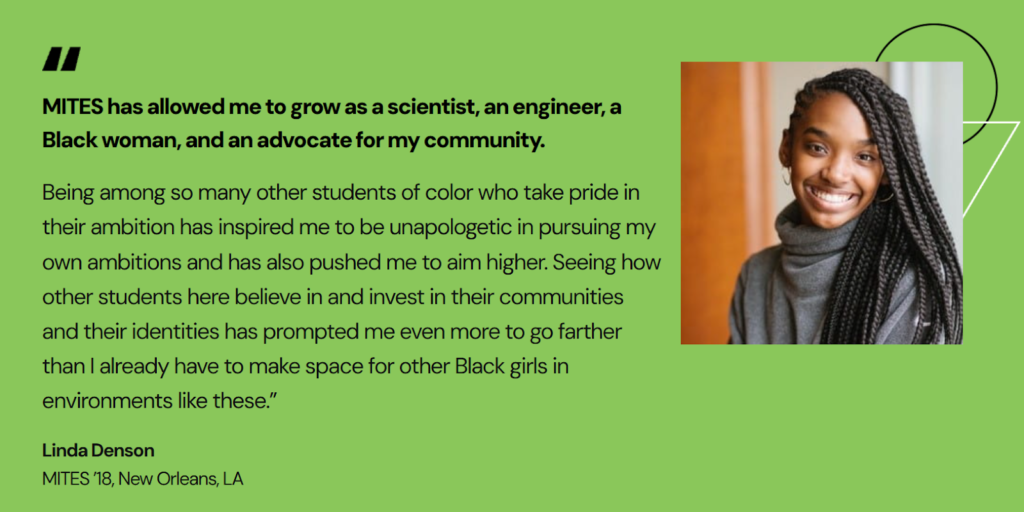
Alumni emphasize the program’s role in building confidence, clarifying academic interests, and preparing them for the rigor of college-level work.
Jose Aceves-Salvador (MITES ’16) describes MITES as a turning point, noting that the connections he made and the confidence he gained helped him take on challenges he hadn’t anticipated.
Yenifer Lemus (MITES ’21) speaks on how the program helped her move from a large urban high school to a rural college campus. MITES, she explains, acted as a bridge between two very different academic environments, making the transition less disorienting.
Is MITES Summer Worth Your Time?
Whether the MITES Summer Program is worth your time depends on what you want from a summer experience. MITES asks you to show up every day, follow a fixed schedule, and stay engaged across several subjects at once. You spend long hours in class, then more time working through problem sets and readings on your own. There is not much room to slow down or step away. If you need flexibility or are looking for a lighter commitment, this may feel like a heavy use of your summer.
If you want to understand how you handle college-level work before senior year, the program offers something concrete. You see how you manage deadlines, where you struggle, and how you respond when material moves faster than expected. You also receive written feedback from instructors who have watched you work closely for weeks. By the end, you have evidence from your own experience, and for many students, that clarity is what makes the time investment feel worthwhile.
One more option – Horizon Academic Research Program
If you’re looking for a competitive mentored research program in subjects like data science, machine learning, political theory, biology, and chemistry, consider applying to Horizon’s Research Seminars and Labs! This is a selective virtual research program that lets you engage in advanced research and develop a research paper on a subject of your choosing. Horizon has worked with 1000+ high school students so far and offers 600+ research specializations for you to choose from. You can find the application link here!
Image Source: Horizon Logo