

Some high school students hit a stage where high school learning stops challenging them after a point. You may find yourself pushing back on explanations or wanting to understand how ideas hold up when they are examined more closely.
Many summer programs add activity, not depth. The Davidson THINK Summer Institute takes a different approach. It centers on how subjects are explored in serious academic settings, where discussion matters, reading is careful, and ideas are not rushed. You spend time thinking, revising your views, and learning from others who are just as engaged.
What Is the Davidson THINK Summer Institute?
The Davidson THINK Summer Institute is a residential academic program for students aged 13 to 16 in high school. Hosted by the Davidson Institute, it takes place on a college campus and brings together students who want to work through ideas quickly and seriously.
Classes at THINK are small and discussion-based. You spend time reading, analyzing problems, and talking through ideas with instructors and peers. The emphasis is not on memorizing content but on learning how subjects are handled when the focus shifts to reasoning, evidence, and explanation.
Program Overview
Program type: Residential summer program
Location: University of Nevada, Reno (UNR)
Program dates: Typically three weeks in mid-summer (historically runs mid-July through early August)
Application Deadline: Applications typically open in January and close in late March
Cost: Approximately $4,000-$4,500 tuition and a non-refundable deposit required within two weeks of acceptance (covers tuition, room, and board)
Financial aid: Limited need-based aid available
Eligibility and Selection
Students ages 13 to 16 (typically rising 8th through 11th graders) are usually eligible to apply. The selection review process looks for clear evidence that you can handle abstract material, sustained reading, and discussion-heavy classes without extensive scaffolding. Academic records, test scores, written responses, and recommendations are considered together.
How Does the Application and Selection Process Work?
The application process for the Davidson THINK Summer Institute is designed to assess academic readiness and fit, not to reward polish or volume. You apply once, submit a focused set of materials, and wait for a holistic review.
When you apply, you are typically asked to submit:
- Academic records that reflect your current level of coursework
- Written responses that explain how you think, not just what you know
- At least one recommendation from a teacher who has seen you handle advanced or discussion-based work
Applications are reviewed individually. Reviewers look for patterns: how you approach complex ideas, how clearly you explain your reasoning, and whether you are ready for an environment where discussion and preparation are central.
Some applicants may be asked for additional information if reviewers need more context about their academic background or readiness. Because class sizes are small, selection is limited, and decisions are made based on how well applicants fit the structure and pace of the program.
How Are Applications Evaluated?
Selection focuses on academic behaviors. Reviewers pay attention to:
- Your ability to work with unfamiliar material
- Evidence of careful reading or problem-solving
- Willingness to engage with ideas that do not resolve quickly
- Signs that you can benefit from direct feedback
When will results/acceptances be announced??
Families are notified by email once the review process for the program cycle is complete. Because applications are read carefully and compared across a small pool, decisions are not released immediately after submission.
What will I learn as a participant?
The skills you develop at the Davidson THINK Summer Institute come from the work you do every day. Everything grows out of how classes function and what is expected of you.
Careful reading and evidence-based thinking
You spend a lot of time with challenging texts and return to them often. In discussions, you are expected to point to specific passages, ideas, or data to support what you say. Over time, this trains you to rely on evidence rather than impressions.
Academic discussion and reasoning
Most classes revolve around conversation. You practice explaining your thinking clearly, responding to opposing views, and adjusting your position when stronger arguments emerge. These discussions happen without scripts or prepared answers.
Big-picture and connected thinking
Courses often require you to move past isolated facts. You are asked to link ideas, track patterns, and think about how different parts of a subject relate to one another. This kind of thinking becomes routine across classes.
Managing work independently
You are responsible for keeping up with readings and preparation without constant reminders. This pushes you to plan your time, decide what deserves extra focus, and handle a demanding academic pace.
Working with feedback
Feedback comes quickly and often, sometimes in the middle of a discussion. You learn how to listen closely, clarify misunderstandings, and revise your thinking without becoming defensive.
Staying with difficult ideas
Some questions do not resolve neatly. You learn to stay engaged when things feel unclear, revisit earlier ideas, and keep working even when progress is slow.
Tips to strengthen your application
- Be specific about how you handle challenges and feedback
- Ask recommenders who know your learning behaviors well
- Demonstrate readiness for sustained acceleration
- Avoid trying to fit a perceived “gifted” mold; fit matters more
A practical tip from Davidson Academy students and families: Have a trusted adult review your application materials for clarity and completeness, not to polish away your voice. The Academy values authenticity, self-awareness, and evidence of readiness over perfection.
10 Reasons to Apply to the Davidson THINK Summer Institute
The points below describe features that matter if you are deciding whether this academic environment fits how you learn.
- To earn real college credit
Students at THINK typically earn university credit, often up to six credits, through the University of Nevada, Reno. These credits are attached to actual courses and appear on a college transcript.
- To take defined university-level courses
Courses are not themed seminars or exploratory workshops. You enroll in specific classes with set content, expectations, and assessments, similar to what undergraduates take.
- To experience college academics at a younger age
THINK is designed for students roughly between 13 and 16 years old who are already ready for advanced coursework. It offers early exposure to college-style learning without requiring full-time enrollment.
- To live on a college campus with structured supervision
The program is residential. You live in campus housing, manage daily routines, and move between classes independently, while still operating within an environment designed for younger students.
- To study alongside profoundly gifted peers
Students apply because the peer group is unusually narrow. Many participants have skipped grades or completed standard curricula early, which changes how classes and discussions function.
- To work at a faster academic pace than school allows
Courses move quickly and assume prior mastery. Students apply when they want to work at a level that does not pause for review or repetition.
- To engage with material beyond the enrichment level
Assignments and discussions focus on core academic content, not surface exposure. You are expected to understand concepts deeply, not just be introduced to them.
- To test readiness for sustained advanced work
Some students apply to see how they handle the workload, expectations, and independence that come with higher-level study before making longer-term academic decisions.
- To learn in an environment without age-based placement
Classes are organized by readiness rather than grade. Students apply when age-based grouping has become a barrier rather than a support.
- To experience a short but intensive academic stretch
THINK runs for a limited time. Students often apply because they want a concentrated academic experience rather than a full-year commitment.
Student insights and feedback
Student testimonials consistently emphasize the social and intellectual alignment of the Academy. Many students describe entering after feeling isolated or under-challenged elsewhere and finding a community where intellectual curiosity is shared.
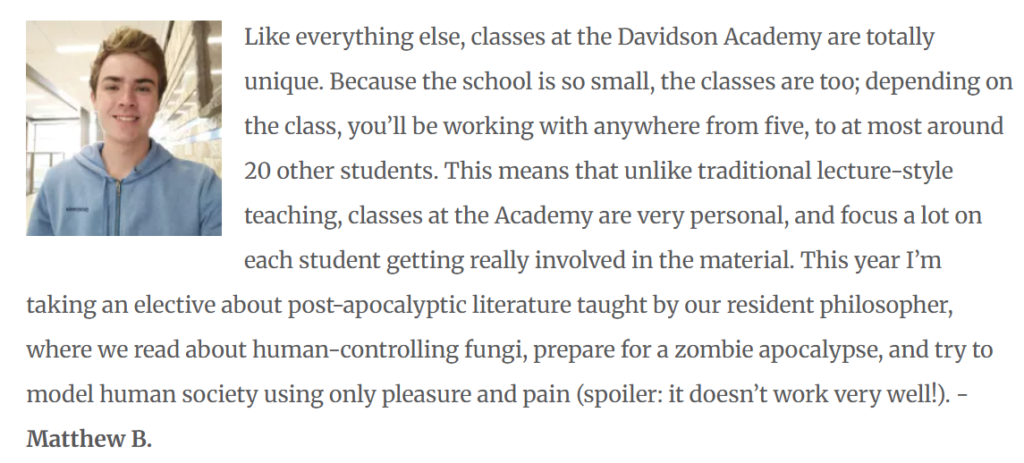
Common themes include:
- Ease of forming friendships with intellectual peers
- Collaborative rather than competitive culture
- Small, discussion-driven classes
- Interaction across age groups due to ability-based placement
- Freedom to pursue diverse extracurricular interests

First-hand student and family perspectives are available through the Davidson Institute Resource Library, which includes blogs, testimonials, and alumni reflections.
Is the Davidson THINK Summer Institute worth your time?
If you’re comfortable with fast-paced reading, sustained discussion, and working through ambiguity rather than closed answers, THINK can be a revealing few weeks. You’ll see how you reason when the room expects precision, how you respond to direct feedback, and how you manage your own preparation without a set syllabus hanging over you.
If you want a lighter enrichment experience, an overview course, or something that feels like school with fun on the side, THINK will probably feel heavy and slow. It is not designed to boost a checklist or be an easy résumé highlight. It’s designed to expose you to the mechanics of advanced academic work.
For some students, the shift in expectations is energizing. For others, it shows exactly what they need to work on before attempting intense academic environments again. In that sense, the program is worth your time if you want clarity about how you learn and think, and if you’re ready to put in focused intellectual effort over a concentrated period, not just add another summer activity to your list.
One more option – Horizon Academic Research Program
If you’re looking for a competitive mentored research program in subjects like data science, machine learning, political theory, biology, and chemistry, consider applying to Horizon’s Research Seminars and Labs! This is a selective virtual research program that lets you engage in advanced research and develop a research paper on a subject of your choosing. Horizon has worked with 1000+ high school students so far and offers 600+ research specializations for you to choose from. You can find the application link here!
Image Source – Davidson THINK Summer Institute